
Alesis SR-16: archive extraction, catalogs and playback limits
Preserving the supplied recordings and their metadata without confusing an archive inventory with a complete hardware ROM.
Technical research · edition 2 · reviewed 2026-10-24
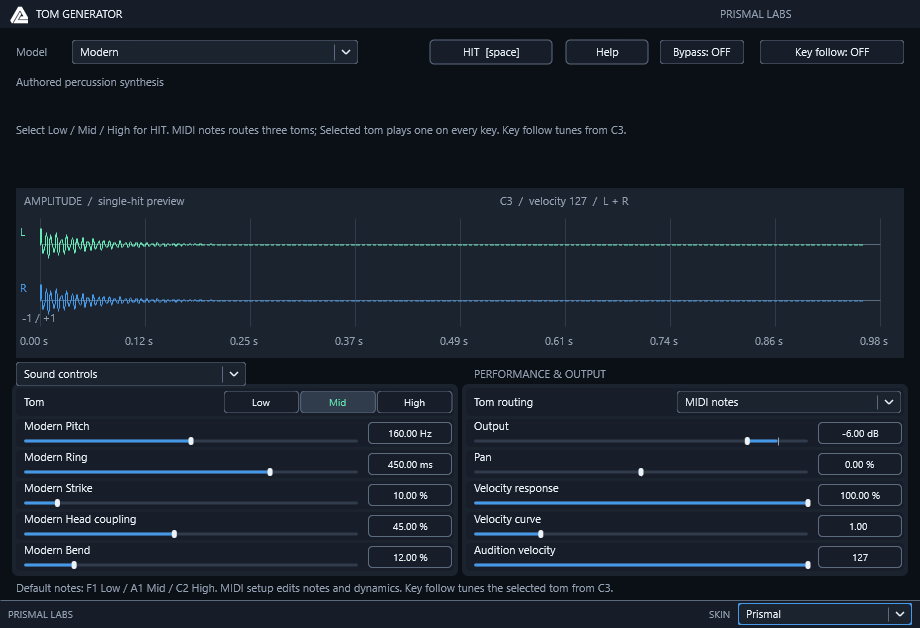
Prismal Labs native editor capture, illustrating the corresponding software project. View full-size image
What we found
Our SR-16 work produced a verified inventory of a supplied recording archive, not a ROM dump. The archive contains 229 recordings, and preserving their identities and bytes proved more useful than assigning guessed factory numbers. This distinction matters when a usable sample collection is smaller than the advertised instrument inventory or has incomplete capture provenance.
The reusable contribution is the extraction/catalog method: disable transformations, validate WAV geometry before copying, preserve stable source identity, and verify hashes afterward. We also separated actual archive playback from undocumented velocity articulation and machine-wide voice allocation.
Extraction and the full inventory
On 2026-09-05 the supplied Alesis SR 16 Refill.rfl was opened in Reason 12.
The archive's sample folders contain 48 kicks and 181 other recordings (229 total).
This is the supplied archive inventory, not a claim to have all 233 factory voices
or an authenticated ROM dump. Factory voice numbers and recording conditions remain
unverified. Source: Archive.org AlesisSr16Refill.
The non-kick folders Snares, Hats, Toms and Ethnic _ Misc were imported into a new Reason document. All clips were selected, stretching disabled, and bounced to new samples at clip level (0 dB, no fades or transpose). The user completed the export folder selection because native automation could not activate that modal dialog. The original ReFill, earlier kick exports and new exports are retained locally.
tools/organize_sr16.py validates WAV format and filename classification before
copying anything. It preserves every exported file byte and verifies SHA-256 after
copying into Drums/<Product>/models/SR-16/samples. It refuses changed destination assets
and unknown names. Committed sibling catalog.json files contain stable archive
identities, hashes, PCM metadata and multiple sound tags. Tags describe archive
names/folders, not verified capture settings or factory sound IDs. Ambiguous fish
and impact voices stay in PercussionGenerator rather than acquiring an invented
instrument identity.
The organizer defaults to the repository's Drums/ product container. An explicit
--output-root selects another container for <Product>/models/SR-16/ folders.
It does not change the source recordings or the catalog identities.
| Product | Recordings |
|---|---|
| KickGenerator | 48 |
| SnareGenerator | 58 |
| HiHatGenerator | 18 |
| TomGenerator | 52 |
| CymbalGenerator | 12 |
| ClapGenerator | 2 |
| RimGenerator | 2 |
| ClaveGenerator | 3 |
| WoodblockGenerator | 4 |
| CongaGenerator | 6 |
| CowbellGenerator | 6 |
| AgogoGenerator | 2 |
| TriangleGenerator | 1 |
| TambourineGenerator | 1 |
| ShakerGenerator | 2 |
| TimbaleGenerator | 3 |
| SnapGenerator | 2 |
| PercussionGenerator | 7 |
Evidence: research/drums/SR16-EXTRACTION.md.
What the hardware behavior still requires
The manual documents velocity-dependent timbre for many recorded sounds, 127 MIDI velocity levels, and four assignment modes: Multi, Single and two mutually exclusive groups. It has a 16-voice pool and steals the voice nearest its end. Tuning positions range from -4 to +3; that display alone does not prove semitone spacing. Alesis Reference Manual Rev C, sections 1.2 and 4.5–4.6
The current per-product 24-voice oldest-first allocator, eight steal tails, continuous transpose/trim and gain-only velocity are plug-in behavior. Preserve unmodified archive playback at center pan, unity source speed, full length and known gain. Do not fake undocumented articulation by arbitrary filtering. Add assignment choice with an explicit per-instance scope; a complete hardware-wide 16-voice pool would require a shared rack. Recorded dynamic layers, factory-ID mapping and exact tuning-table behavior remain evidence gaps.
Evidence: research/drums/HARDWARE_REVIEW_V2.md.
Identity is more than a filename
A catalog entry should retain source archive, original folder/name, immutable recording ID, byte hash, sample rate, channel count, sample format and frame count. Classification tags are descriptive metadata, not a replacement for that identity. An ambiguous impact stays ambiguous instead of acquiring a confident but invented instrument label.
For uncompressed PCM, the payload geometry should satisfy frames = dataBytes / blockAlign, where blockAlign = channels * bytesPerSample; reject a partial frame. Duration is frames/sampleRate. Byte-for-byte hashes verify copying, while a decoded-audio comparison answers a different question if a container has legitimately changed. Neither proves the recording's hardware origin.
At unity source pitch, center pan and known gain, compare the complete stereo output with the selected recording. Then test tail truncation, transposition and voice stealing separately. A first-matching-tag search is not a reproducible articulation selector: store explicit recording IDs for closed/open/pedal slots.
Applying the findings
Use this workflow for any sample-based research collection. Keep acquisition provenance separate from classification and playback settings. Make missing or ambiguous metadata visible; do not infer microphone, velocity layer, factory ID or processing from a suggestive filename.
For distribution, publish the inventory and method independently of the PCM. A self-contained bank can be technically portable while its source rights remain unresolved. In our case, the archive's conflicting metadata and author restrictions keep the recordings and binaries containing them private.
Limits and open questions
The inventory is not all 233 factory voices. Recording conditions, factory-number mapping, dynamic layers and the SR-16 Dynamic Articulation mechanism remain unverified. Gain-only velocity does not recreate that mechanism. The original 16-voice/nearest-end stealing behavior is also distinct from the per-product software allocators.
Research illustrations
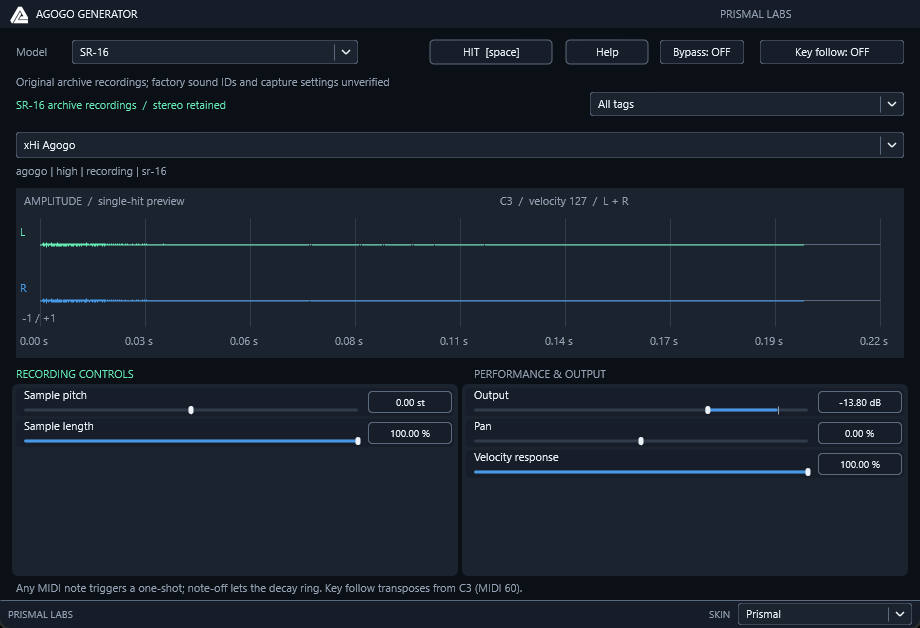
Prismal Labs native editor capture, illustrating the corresponding software project. View full-size image
Primary references
Research provenance
The methods and results above are drawn from these retained research records. Dates and product versions inside the article identify the scope of each experiment; publication review does not mean the hardware or numerical tests were rerun.
research/drums/SR16-EXTRACTION.md— SHA-25614d48d3e043bb2a2395fe3cad452593330b3449b41c4fd15896a70e8b4224a01research/drums/HARDWARE_REVIEW_V2.md— SHA-2564b556e1ed4bedcd8d3649d781a7c1bd8fab0693939519ce27e387c11a0e60e42
Related projects
KickGenerator · SnareGenerator · HiHatGenerator · TomGenerator · CymbalGenerator · ClapGenerator · RimGenerator · ClaveGenerator · WoodblockGenerator · CongaGenerator · CowbellGenerator · AgogoGenerator · TriangleGenerator · TambourineGenerator · ShakerGenerator · TimbaleGenerator · SnapGenerator · PercussionGenerator