
Native plugin engineering: independent tests and evidence boundaries
The shared research method for numerical references, state, realtime processing, editor rendering and actual host behavior.
Technical research · edition 2 · reviewed 2026-10-24
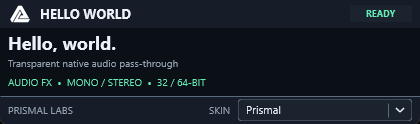
Prismal Labs native editor capture, illustrating the corresponding software project. View full-size image
What we found
Across the plug-in family, the recurring lesson was that different tests answer different questions. An equation-level pass can coexist with unacceptable CPU cost; an SDK validator can pass while a host routes no input; an editor capture can look correct while a menu gesture or saved state fails. We kept those layers separate and tied each receipt to the actual source and module it tested.
This article describes the reusable validation method behind the research. Its purpose is to help another developer build evidence that can explain a failure, rather than collect a single broad “passed” label.
An evidence ladder with distinct conclusions
| Evidence | What it can establish | What it cannot establish alone |
|---|---|---|
| Independent branch equations or analytic reference | Correctness of the declared mathematical model and residuals | Measured original-hardware sound |
| Rate convergence and event-time comparison | Numerical behavior as the integration clock changes | Adequate worst-case callback time |
| Allocation/work-budget checks | Bounded resource behavior on exercised paths | All host/OS scheduling deadlines |
| Processor tests with varied blocks | Bus behavior, sample offsets and state transitions | Installed module discovery in a specific DAW |
| SDK validator | Compliance with its exercised interface cases | Correct musical routing or listening quality |
| Installed-module processing | Behavior of the exact loadable bundle | Every DAW's session lifecycle |
| Native UI interaction/capture | Rendering and actual tested gestures | Audio correctness |
| DAW routing/playback/save/reopen | The recorded host workflow and module | Other platforms, future builds or perceptual realism |
An oracle should not reuse the same recurrence or reduced equations as the code it checks. For example, compare a reduced output port against an unreduced nodal system, or a packed FFT against a direct DFT. Agreement between two wrappers around the same implementation is weaker evidence.
Useful failures from the research
The circuit studies supply concrete examples. Cowbell current-sign and low-voltage fit checks found problems that a nominal full-level render could miss. The snare model briefly reached finite amplifier limits, invalidating an assumed virtual ground. The complete bass voice had tiny KCL residuals yet large rate/timing differences and excessive processing cost. Modified Newton reuse passed important numerical checks but ran slower in paired timing tests.
The instrument studies add different failures: a fresh snare default-note path differed from migrated-state behavior; a sax transition splice produced a later energy dip despite acceptable pitch; a neutral transformer needed an aligned original stereo path rather than self-vocoding. Each finding motivated a targeted contract and test, not an unrelated expansion of the test suite.
Sample offsets and state must survive block changes
Render the same notes and automation at fixed absolute sample positions using several block partitions. Include events at zero, immediately before a boundary, exactly on it, and after it. Use half-open callback intervals and a clear same-sample ordering rule. Compare output and emitted events, then exercise zero-frame callbacks and transport resets.
State checks should cover a fresh instance, a valid saved state, legacy readers, truncation and invalid values. A failed load should leave the old state intact. Parameter IDs and serialized meaning belong to the product even when UI or DSP primitives are shared. The transparent HelloWorld processor is a useful framework reference precisely because it introduces no unrelated sound model.
Native visual and host evidence
A practical UI failure in SignalExchange was help text covering the labels it was meant to explain. A reserved bottom information strip removed that obstruction, cleared when no control was hovered, and replaced stale text immediately on a new hover target. Essential control labels remained visible with hints disabled.
The broader testing lesson is to exercise the real gesture through the native editor frame. Directly assigning a parameter can verify its DSP mapping while missing a broken dropdown, canceled menu, focus transfer or host edit gesture. Check selection and cancellation, typed values, Undo, and the resulting sound or routing. Capture the complete frame to expose clipped labels and footer controls.
Appearance choices also need an ownership rule. Our skins and editor page navigation stay outside processor state and automation, so a view change does not change the sound. Screenshots and interaction receipts identify the exact built module and tested size; they are observations of that configuration, not proof about later builds or every theme.
Evidence: DEVELOPMENT_WORKFLOW.md.
Preparing a reusable product boundary
Across the family, the useful unit of reuse was a mechanism with a clear contract. Similar-looking controls did not imply identical musical behavior.
| Reusable mechanism | What remains specific to the instrument |
|---|---|
| Binary readers and writers | Format version, field meaning, limits and migration policy |
| Circuit and DSP primitives | Topology, component values, voicing and validated operating range |
| Parameter publication and host adapters | Stable IDs, units, buses and automation policy |
| Drum processor, preview and editor panel | Articulation identities, note maps, immutable sample data and state |
| Native menu driver and frame utilities | Layout, actual gestures and product-specific assertions |
| MIDI timing and session services | Device routing, transport ownership and worker limits |
For example, SignalExchange retains ownership of its Child/Master meter bus; KeysSequencer owns its hardware ports and transport leases; PL-33 owns its circuitry and sequencer. Moving those policies into a general utility library would couple unrelated instruments. Extract a shared mechanism when another consumer needs the same behavior, and retain independent tests of its assumptions.
This boundary also makes headless validation practical: numerical and state utilities can run without an editor or plug-in SDK. Processing callbacks consume prepared data with bounded work, without allocation, locks, file/network access or UI calls. Expensive preparation and state readers run outside that callback. Sharing an implementation does not transfer a product's hardware-fidelity claim to every consumer.
Evidence: shared/NEW_PLUGIN.md.
Applying the findings
Define acceptance before optimizing. Keep the physical/model assumptions, source/input hashes, executable identity, test signal, sample rate, timing schedule and tolerance in the receipt. When a change alters the numerical trajectory, rerun the independent audit rather than inheriting a previous hash's conclusion.
Measure performance with competing jobs stopped and alternate baseline/candidate run order. Report worst blocks as well as medians. For host delivery, load the exact installed bundle, route the required audio/MIDI, save and reopen an owned test session, and close it normally. Keep user sessions and private reference assets outside disposable fixtures.
Limits and open questions
The retained family visual receipts describe their dated Windows modules and cases. They do not certify later source, all themes/sizes, every host or macOS/AAX. A technical passing result is not a perceptual quality score. The protocol and circuit articles explicitly retain unknowns so downstream users can decide which assumptions their application can tolerate.
Research illustrations
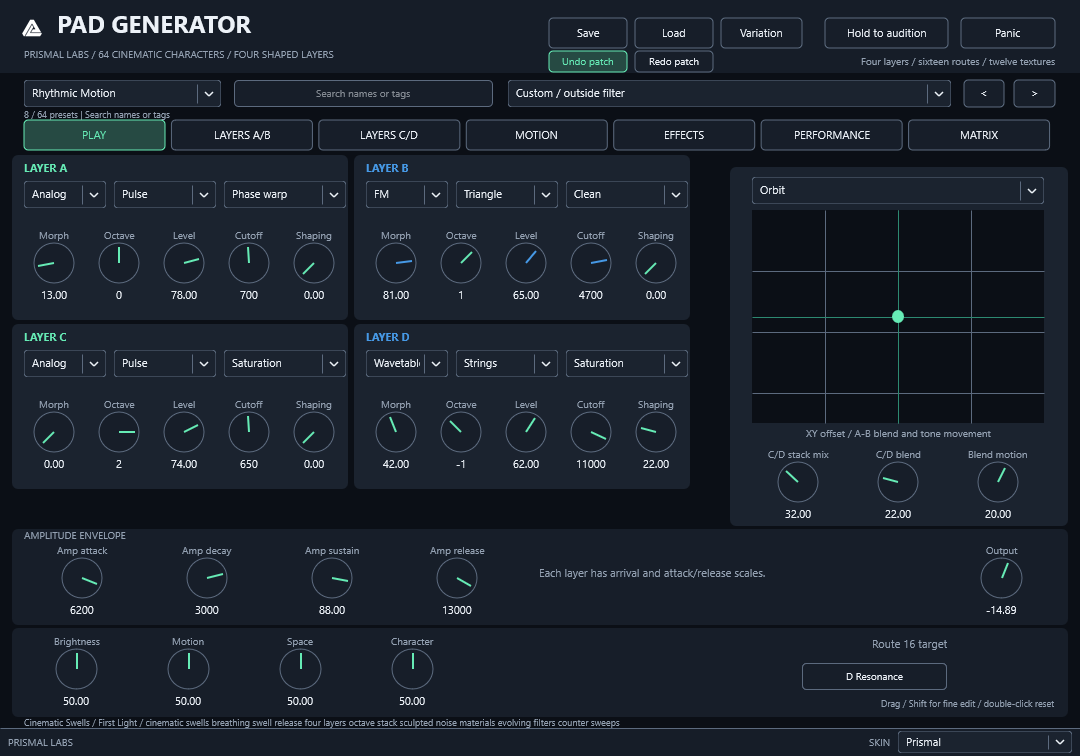
Prismal Labs native editor capture, illustrating the corresponding software project. View full-size image
Primary references
Research provenance
The methods and results above are drawn from these retained research records. Dates and product versions inside the article identify the scope of each experiment; publication review does not mean the hardware or numerical tests were rerun.
shared/FAMILY-VISUAL-VALIDATION.json— SHA-2563f6c47fa0dd99b498b013d0f5f21de9111435d28ee8fd076494d34009df900d4shared/RESUMED-DRUM-VISUAL-VALIDATION.json— SHA-256a48c81c259f0cd63586e5b31bdbcc36a05d69699e1ff24f71ede2b9adcefe301
Related projects
Hello World · PadGenerator · SubGenerator · GranularSynth · VocalGenerator · Vocoder · AudioTransformer · SaxGenerator · StudioAnalyzer · SignalExchange Child · SignalExchange Master · KeysSequencer