Saxophone research: reed acoustics, recordings and connected performance
Investigating four saxophone ranges, expressive control and the limits of measured and recorded comparisons.
Technical research · edition 2 · reviewed 2026-10-24
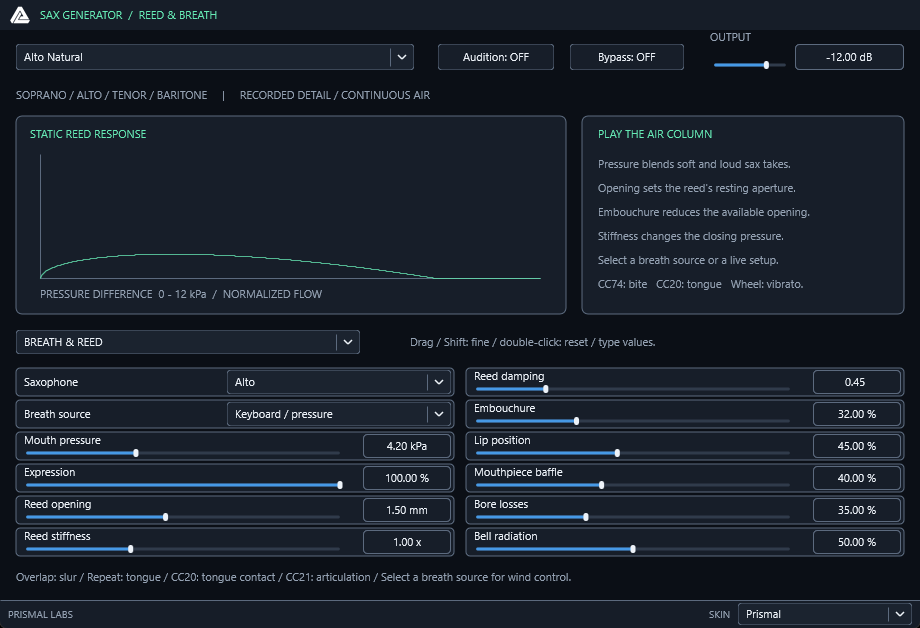
Prismal Labs native editor capture, illustrating the corresponding software project. View full-size image
What we found
The saxophone work changed direction when plausible physical controls and passing engineering tests still left the sound unconvincing. Isolated note quality was not enough: connected arrivals, repeated notes, breath endings and the energy dip between pitches were major parts of perceived performance.
The current study combines source-provenanced recordings and connected-performance evaluation, while retaining the earlier nominal reed/modal investigation as a separate model. Its strongest reusable contribution is the comparison method: hold out real performances, render matching musical phrases and inspect transitions and support across all four sax voicings without treating a green metric as a realism score.
A concrete correction: recorded transitions and splice timing
Version 0.8.10 adds 22 recorded tenor transitions / 19 distinct directed pairs from four original Fares Nofal FLAC stems in the approved JazzSAMBA dataset. Only annotated improvisation regions are used; head melodies and whole held-out compositions are excluded. Original archive CRC/size, waveform geometry, source and annotation hashes and the complete original-data permission are retained. Six new Ornithology cuts rejoin the own sustain by 60 ms with the full 24 ms splice; the other new cuts retain 125 ms. This removes the deep later D→G dip found in the first candidate while preserving performed arrivals. Qualification, timing, pitch and continuity limits remain unchanged. All 861 accepted 0.8.9 records retain exact PCM, metadata and geometry; primary/gesture banks stay exact. Runtime DSP, matrix depths, IDs, state, latency and shared UI are unchanged.
Evidence: SaxGenerator/RESEARCH.md.
The retained performance results
All four saxes receive the same full pass: 800 renders of the original hook, 24-bar solo, legato bridge, Low Answers and new twelve-bar / 76-note Tenor Changes phrase. Natural plus all nine articulations are tested in Wind, Keyboard, Neutral and moving Live profiles. Genuine overlaps, repeated ghosts, fast runs, accents and breath endings are included. Every new tenor pair appears in the new Natural phrase; all original four scores remain unchanged. Both banks use identical new scores. All 600 music renders for the other three saxes are exact to the prior bank; 52 tenor renders change with closer recorded handovers.
All 325 dry variants / fourteen held-out recordings, 364 controller renders and 342 sample-exact neutral comparisons pass. Fourteen recordings are not fourteen identified players. All 1,128 transition/breath cases pass: median 15 ms, p95 20 ms, maximum 45 ms, minimum continuity 0.4191. The 456 focused new-pair trials pass with maximum 36 ms and minimum continuity 0.4892. These are windowed detector estimates, not physical fingering/tongue timing. All 300 primary / 266 performance attacks and 133 endings pass unchanged wrong-register screening. Explicit Scoop/Fall/Doit retain their intended pitch gestures.
The private tenor reference protocols rerun all 33 purpose-exercise microphone
takes from one player, concert MIDI 44–76: 1,188 renders / 2,277 checks, all
passing and sample-exact to accepted 0.8.9. The five-player / 28-run trill protocol
reruns 1,120 renders with unchanged gates and zero flagged renders. Forty Natural
and eighty articulation WAVs change with closer recorded intervals; all five
current waveform/unfolded-pitch panels were regenerated and visually inspected.
Exercise comparisons (../build/sax-source-search-20261020/jazz-expansion-0810/candidate-compact/Purpose-Exercises.md, retained research) and
trill comparisons (../build/sax-source-search-20261020/jazz-expansion-0810/candidate-compact/Trill-Comparisons.md, retained research) retain real audio and every
articulation/profile. These NC references stay private and outside the bank.
The 883-record performance bank has 345 connected captures / 239 distinct directed pairs: soprano 36/32, alto 112/73, tenor 144/95 and baritone 53/39. Performed same-pitch captures remain 4/69/0/25. Coverage is partial. Purpose- recorded normal tenor repeated-tonguing bank audio remains missing. Song phrases, scale entries, trills and isolated round robins do not satisfy that requirement. The approved JazzSAMBA original-data grant remains allowed. Other new bank sources must be freely accessible Creative Commons permitting commercial use; NC recordings stay in private references, outside all banks/installers. No players were contacted.
Evidence: SaxGenerator/RESEARCH.md.
What the earlier physical model taught us
Use an original coupled reed/modal model rather than a static sax wavetable. It permits continuous reed opening and bite changes without sample layers. Normalize mouth pressure by 6 kPa and opening by 1.5 mm. These are explicit nominal scales, not an asserted measurement of a particular player or reed. The bore's modal pressure depends on airflow, and the reed force depends on the pressure across the reed. The upstream tract shares that airflow. This feedback is what distinguishes breath-driven timbre from output-gain automation.
The model uses trapezoidal resonator integration and an exact scalar scattering solution for the aperture held during each internal tick. Reed mechanics are advanced after scattering, giving a partitioned coupling error that must be checked by rate convergence. Unilateral contact is inelastic. Production runs at an integer multiple of the host rate at or above 192 kHz, followed by a prepared Blackman-windowed sinc FIR with a 32-host-sample delay. Noise paths share that delay; nonlinear output coloration is applied before decimation. Sixteen bore modes and one tract mode give fixed work and storage bounds.
The independent audit integrates the unreduced continuous ODE states with
DOP853; it does not reuse the production recurrence or algebraic root. Its
small-signal result cannot validate reed collisions, playable register changes
or the timbre of real saxophones. See model validator (tools/validate-model.py, retained research)
and the current handoff (HANDOFF.md, retained research).
Evidence: SaxGenerator/RESEARCH.md.
Actual host evidence and its limits
All four fresh actual Ableton processes load the exact installed 0.8.10 module and retain the accepted 0.8.9 684-byte processor states: correct model, Keyboard source, Momentary/C0 keys, Direct MIDI Off, six routes and wheel 30%. Each new phrase delivers all 76 audible notes, six natural modes and moving wheel, aftertouch, CC4/CC64. Exports are 52 beats / 112 BPM / 48 kHz stereo PCM24, Normalize Off, Room zero and No Dither. Eligible 64 ms pitch segments pass: Soprano 64, Alto 64, Tenor 64, Baritone 64. Forty-four short ghosts have a separate limited 32 ms register diagnostic; all are assessed with no persistent wrong register detected. Stable windows do not certify every fast transition. All owned Live PIDs close normally; the user's preferences are restored byte exactly.
Real players still vary support, tongue shapes and transition energy more than these renders. Soprano support evolves differently after the entrance; the held-out alto detaches more deeply; tenor starts earlier relative to its approximate score; baritone swells more gradually and dips support ahead of the illustrated change. Native wide-leap support is more uniform and semitone motions rounder. Different players/microphones and approximate transcription limit attack/release equivalence. An unavailable tail is not a zero physical breath release. Unvoiced air and very fast transitions have limited pitch coverage. These checks do not certify perceptual realism, every-instant pitch or physical keyboard latency. macOS/AAX remain separate.
The 883-record performance bank has 345 connected captures / 239 distinct directed pairs: soprano 36/32, alto 112/73, tenor 144/95 and baritone 53/39. Performed same-pitch captures remain 4/69/0/25. Coverage is partial. Purpose- recorded normal tenor repeated-tonguing bank audio remains missing. Song phrases, scale entries, trills and isolated round robins do not satisfy that requirement. The approved JazzSAMBA original-data grant remains allowed. Other new bank sources must be freely accessible Creative Commons permitting commercial use; NC recordings stay in private references, outside all banks/installers. No players were contacted.
Evidence: SaxGenerator/COMPARISON.md.
Why the evidence changed the development target
The nominal model uses mouth pressure, reed opening and bore response in feedback. Pressure affects flow, flow excites the bore, and bore pressure changes the force across the reed. That is more meaningful than calling output-gain automation “breath modeling,” but an assumed impedance model still lacks measured fingering and performer behavior.
The recording work addresses a different part of the problem: how a performed arrival joins a sustained note and how support evolves through a phrase. A 60 ms versus 125 ms rejoin point can matter even when both candidates pass basic pitch checks. Preserve the source waveform and compare the complete handover, not only the steady middle of the destination note.
Recorded transition coverage is counted as directed pairs. A low-to-high interval does not establish the corresponding high-to-low transition. Same-pitch tonguing is another category; trills, scale entries and isolated round robins do not automatically supply it.
Applying the findings
For another expressive instrument, evaluate at least three layers: isolated tones, directed transitions, and complete musical phrases with real controller movement. Use held-out performances and record which material entered the bank versus the comparison set. Compare onset, support, release and intended pitch gestures separately.
Use windowed pitch estimates only where the signal supports them. A stable 64 ms window cannot certify a fast ghost note or every instant of a transition. Keep detector timing distinct from physical player or keyboard latency. Preserve failed candidates and explain the audible issue that motivated a correction.
Limits and open questions
Coverage remains partial, and purpose-recorded normal tenor repeated tonguing is still missing. Fourteen held-out recordings are not fourteen identified players. Differences in microphone, player and approximate transcription limit direct equivalence. Noncommercial reference recordings remain private and outside the bank; approved source grants and notices remain attached to distributed material. The earlier physical model's small-signal audit does not certify reed collision behavior or the current recording bank.
Primary references
Research provenance
The methods and results above are drawn from these retained research records. Dates and product versions inside the article identify the scope of each experiment; publication review does not mean the hardware or numerical tests were rerun.
SaxGenerator/VALIDATION.json— SHA-256f8242fed05257681f4fabd18c35190175f431e123490a1dc2428341e3ee5d46fSaxGenerator/RESEARCH.md— SHA-256a9ff579edd8f7a85e1843dd8508951f62732927dccf2a4e8aaf94b0786c397eaSaxGenerator/COMPARISON.md— SHA-2563590a39fac45deea4f81703ab29f9de426b07efaba3c70c586994ec4fbf5d6b5