
TR-808 hats and cymbal: metallic sources and loaded filters
Investigating the six continuously running rectangular sources and the boundary between circuit-derived tone and authored damping.
Technical research · edition 2 · reviewed 2026-10-24
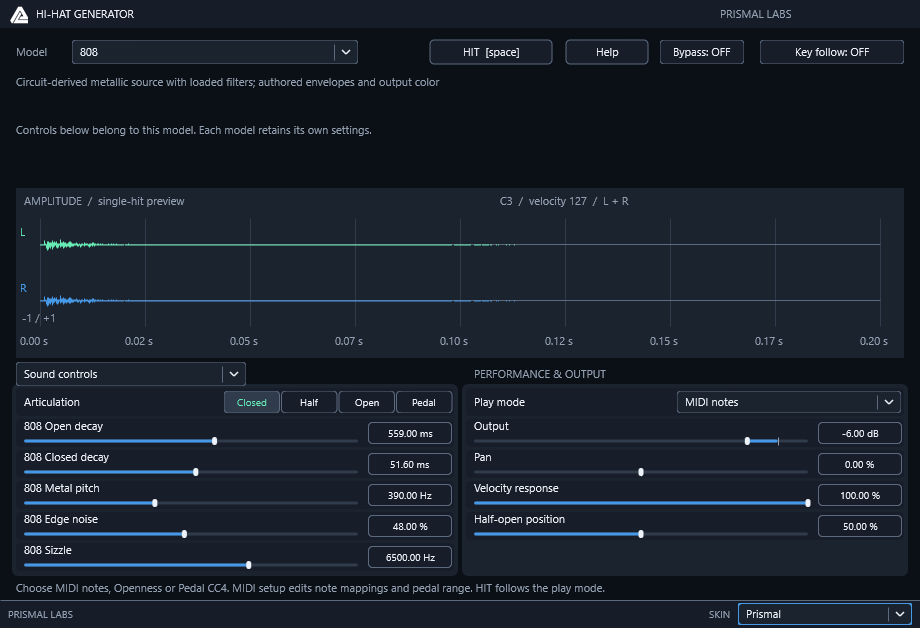
Prismal Labs native editor capture, illustrating the corresponding software project. View full-size image
What we found
The hi-hat study showed that oscillator lifetime and loading matter before any envelope is applied. A six-oscillator metallic bank should continue running between hits, and the unused low-band input still loads the shared summing bus. A set of reset sines followed by an isolated band-pass does not preserve either property.
We derived a loaded fourth-order front-end transfer and checked it against five-node complex KCL. The resulting implementation deliberately stops at the high-band op-amp output; the envelopes and damping after it remain authored controls. That boundary is useful to anyone building a metallic percussion source without claiming a complete hardware reconstruction.
Source timing and component values
Both banks use a conditional Schmitt threshold proxy: low/high 0/5 V, lower/upper
2.1/2.7 V. These are published typical MC14584B values, not measured HD14584BP
thresholds. The duty is 47.9805%. RC timing is
1/[RC*(ln((5-2.1)/(5-2.7))+ln(2.7/2.1))].
| Source | 808 | 606 (earlier R226 revision) |
|---|---|---|
| 1 | Service trim target 540 Hz (TM1/C6) | R224/C97: 330 kohm / 10 nF |
| 2 | Service trim target 800 Hz (TM2/C5) | R225/C98: 470 kohm / 10 nF |
| 3 | R43/C4: 220 kohm / 18 nF | R226/C99: 330 kohm / 15 nF |
| 4 | R42/C3: 680 kohm / 10 nF | R244/C107: 560 kohm / 15 nF |
| 5 | R41/C2: 560 kohm / 10 nF | R245/C108: 560 kohm / 12 nF |
| 6 | R40/C1: 560 kohm / 18 nF | R246/C109: 470 kohm / 12 nF |
The 606's annotated R226=680 kohm lot variation is not selected by this nominal model. It needs same-unit captures before a revision selector or calibration claim. Neither bank is a scaled six-sine preset. PolyBLEP smoothing is a numerical edge treatment; it is neither a transistor model nor an ideal brick-wall source.
Evidence: research/drums/HIHAT-MODEL-NOTES.md.
Keep both filter inputs in the denominator
The six summing resistors are 120 kohm for 808 and 150 kohm for 606; the bus
ground resistor is 1 kohm. High-band input is 22 kohm / 1 nF, low-band input is
33 kohm / 3.3 nF. High feedback uses 82 kohm, a 560-ohm midpoint-to-ground
resistor, and two 3.3 nF capacitors. See source/metallic_source.h for units.
Let G=6/Rsum+1/Rbus, th=Rh*Ch, tl=Rl*Cl,
a=Rg*(Ca+Cb) and b=Rg*Rf*Ca*Cb. The bus denominator is
B(s)=G+s*(G*(th+tl)+Ch+Cl)+s²*(G*th*tl+Ch*tl+Cl*th).
From the sum of source voltages, the high-band transfer is
H(s)=-(Rf*Ch/Rsum)*s*(1+s*a)*(1+s*tl) / [B(s)*(1+s*a+s²*b)].
The low-band branch remains in the denominator even though its audio output is
outside this model boundary. The implemented fourth-order bilinear filter is
checked against unreduced five-node complex KCL, including both input-capacitor
nodes and the feedback midpoint. An unloaded mixer/band-pass cascade is not used.
Evidence: research/drums/HIHAT-MODEL-NOTES.md.
Continuous sources and explicit articulation
The Roland TR-808 service notes, June 15, 1981,
printed pages 6 and 13, show the shared six-Schmitt metallic bank, parallel
band-pass inputs, distinct OH/CH gates and closed-hat interruption of open decay.
The maintained 606 circuit ledger (606-CIRCUIT-NOTES.md, retained research) records its own RC bank,
filter inputs and manufacturing-lot ambiguity. The
hardware review (HARDWARE_REVIEW_V2.md, retained research) identifies the missing original digital
hat waveforms and the old first-matching-tag recording substitution.
The implemented circuit boundary stops at the high-band op-amp output. It includes ideal rectangular 0–5 V sources, six summing resistors, the grounded bus resistor, both series RC filter inputs and the high-band feedback network. It assumes ideal inverter outputs and ideal linear op-amps. It omits the nonlinear gate, envelope, later output filters, rail/headroom behavior and unit calibration. Those omitted stages are represented by explicitly authored envelopes, damping and sound controls. This is a circuit-derived metallic front end, not a claim that the entire 808 or 606 hat circuit has been solved.
Both source banks run continuously after their first trigger, including between notes; gate changes do not reset their oscillator phase or filter histories. Transport/state/bypass reset clears them. Each channel has its own source bank so chromatic retuning and choking cannot change another MIDI channel's hat. Retuning a channel changes its shared source, including a closing two-millisecond tail on that channel. A fresh instance starts from deterministic source phases.
Open/Closed decay values are software T60 values. Half-open position interpolates geometrically between them; the default midpoint is 50%. Pedal uses 38% of closed T60 with a 6–120 ms bound and a stronger transient. The circuit voices use a 0.35 ms attack, source voltage normalization, added high-passed pseudorandom noise and a one-pole output color control. These are sound-design choices. Metal pitch, closed decay, edge noise, sizzle and half-open position are extensions and must not be presented as original machine knobs.
SR-16 Selected recording routing plays the explicitly selected PCM for every articulation. Articulation slots instead use four explicitly configurable recording IDs. Defaults are zClosdHat, zHalf Hat, zOpen Hat and zClosdHat for pedal; their names do not prove they are one factory-matched set. No pedal reference exists in the bank, so pedal playback uses a documented 70 ms software damper. There is no first-tag search or automatic substitution. Original stereo and unity pitch/trim PCM are retained, with the common 32-frame processing delay. Archive recordings remain private; factory IDs, capture settings and SR-16 Dynamic Articulation are unverified. 909/707/LinnDrum/DMX remain labelled procedural stand-ins because their original PCM is absent. Modern/Acoustic/Hybrid are authored.
Evidence: research/drums/HIHAT-MODEL-NOTES.md.
What rate convergence actually measured
The production metallic path runs at 8× host rate, then uses the shared FIR reconstruction filter with 32 host frames of delay. PCM/authored voices receive the same delay. Tests compare 8× and 16× against 32× using the same deterministic source/control timestamps with added noise disabled. Acceptance is <3.5% RMS for 8×/32× and <1.5% for 16×/32× at 44.1/48/96 kHz, with decreasing error. This is a numerical convergence bound, not a hardware accuracy percentage. Full-node current residuals are <1 pA in the small-signal oracle.
Product tests cover source continuity, channel isolation, choke timing, pedal damping, all six supported-rate endpoints, dense retriggers, bounded storage and callback allocations. The handoff records actual build/installed/Ableton checks and complete processing timings. Hardware captures, full nonlinear hat circuits and macOS/AAX remain separate unpassed gates.
Evidence: research/drums/HIHAT-MODEL-NOTES.md.
Applying the findings
Derive the bus admittance with every connected input branch present, even if only one branch's output is used. Then compare the expanded transfer with an unreduced nodal oracle before implementing a digital filter. Keep oscillator and filter state independent of the per-hit gate.
For an instrument with multiple MIDI channels, decide whether source tuning and choking are channel-local or shared. Our channel-local banks keep one channel's retune from changing another's ringing hat. This is a software architecture choice, not a claim about separate source banks in the original machine. Test an open hit followed by a close, a hit after a long silent gap, and two channels with different pitch settings.
Limits and open questions
Typical MC14584B thresholds are proxies for the original chip, and the 606 resistor revision changes the source frequencies. PolyBLEP and oversampling address numerical bandwidth; they do not model transistor gates. The percentage errors above compare numerical rates, not resemblance to hardware. Original digital hat waveforms remain unavailable for several other machine models.
Research illustrations
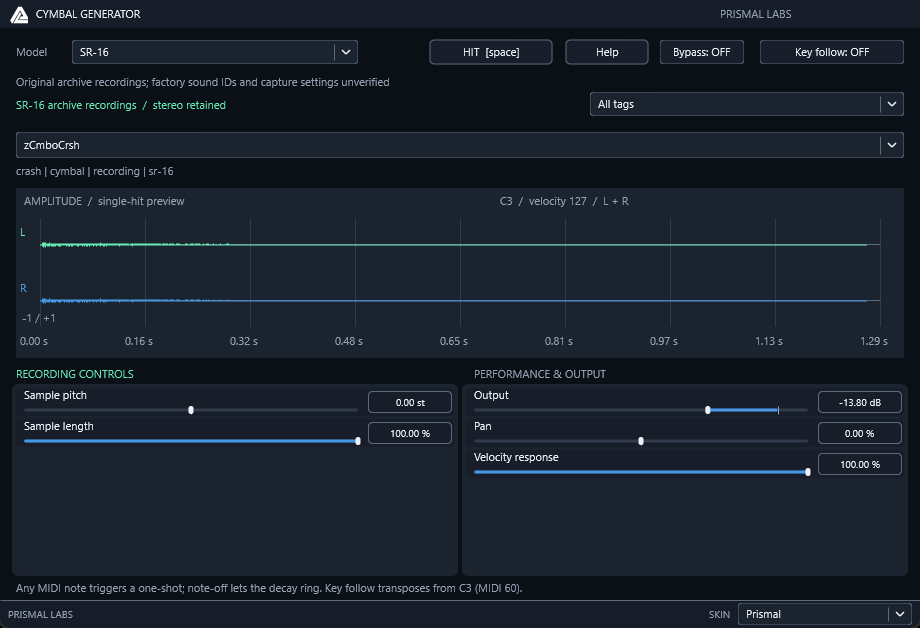
Prismal Labs native editor capture, illustrating the corresponding software project. View full-size image
Primary references
Research provenance
The methods and results above are drawn from these retained research records. Dates and product versions inside the article identify the scope of each experiment; publication review does not mean the hardware or numerical tests were rerun.
research/drums/HIHAT-MODEL-NOTES.md— SHA-25658ebed3c0168cb0ba5e07123440219565e39a8fa4bb71b13936f173dcf5c419c