
TR-808 kick: the bridged-T resonator and retrigger history
Why the bass drum is more than a falling sine, and how research separates the resonator model from authored kick controls.
Technical research · edition 2 · reviewed 2026-10-24
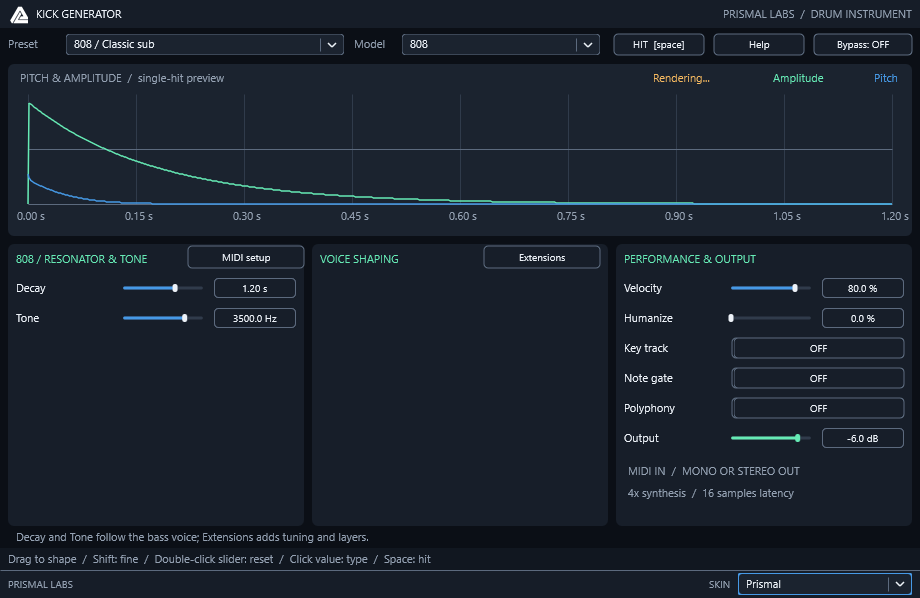
Prismal Labs native editor capture, illustrating the corresponding software project. View full-size image
What we found
The 808 kick work moved from a plausible falling-pitch oscillator to a coupled resonator. The key finding was that excitation, feedback and retained capacitor state explain behavior that a fresh sine plus a second amplitude envelope cannot. Closely spaced hits are a particularly useful test because they reveal the circuit's memory.
We derived a compact three-state system from the published circuit analysis and checked its numerical solution independently. This gives other developers a workable starting point for resonant percussion while making the remaining approximations visible.
The coupled resonator equations
Primary source: Werner, Abel and Smith, DAFx 2014, printed pp.2–7, Fig.3 and trigger/retrigger/leakage/tone sections (R808-DAFX). The paper describes a 1 ms trigger, accent-dependent excitation, a roughly 6 ms attack switch, a bridged-T resonator with feedback, transistor leakage and a passive tone network. A fresh sine plus an amplitude envelope misses capacitor history and excitation-dependent pitch. These are topology facts, not a claim that every original unit sounds identical.
analog_kicks.h uses an independently derived three-state nodal system. With
capacitor voltages u = Vcommon − Vinput and w = Vcommon − Voutput, output
y = p + u − w, and feedback low-pass state z:
Nominal Rb=1 MΩ, C=15 nF, gr=1/1 MΩ, gf=1/470 kΩ; the leg is 6.8 kΩ during attack and 53.8 kΩ afterward. The decay feedback uses h=Rpot/(47 kΩ+Rpot), tau=(47 kΩ+Rpot)*33 µF. Each step solves the coupled trapezoidal equations by elimination, with no allocation. A separate RK4 integration of the nodal equations checks the numerical solution. This checks the solver, not a recording-level match to a physical instrument.
Tune and Decay map to capacitor/feedback changes, extending the stock circuit. For desired angular frequency omega and damping alpha=ln(1000)/T60, a linear two-state approximation gives C=sqrt(G/Rb)/sqrt(omega²+alpha²) and h=2*(1/Rb-alpha*C)/gf. Short decay settings also reduce Rb to keep feedback passive. The slow third state and leakage mean displayed values are targets, not exact measured poles. Component spread and a calibrated control map remain open work. The trigger shelf is approximated with a one-pole update, the diode uses the paper's memoryless fit, and the retrigger shaping is simplified. Output loading and all original coupling capacitors are not yet individually modeled.
Mono retriggers retain capacitor state. Added pitch sweep, modes, noise, distortion, room and polyphony are plugin extensions. The body no longer receives a second full exponential amplitude decay on top of resonator feedback.
Evidence: research/drums/808-909-SR16-IMPLEMENTATION.md.
Why a falling sine was insufficient
Werner, Abel and Smith analyze a shaped trigger exciting a bridged-T network. They distinguish the early frequency jump from the later pitch sigh, and describe tone filtering and output coupling. Their circuit treatment also accounts for behavior when hits arrive before previous ringing has ended. This contradicts the shorthand that an exact 808 is simply one sine with one pitch envelope. Werner, Abel & Smith, DAFx 2014
Design inference: provide a clean fundamental, a fast punch component and a separate slower pitch fall, with long decays and optional key tracking. Use a repeatable attack and short retrigger crossfade for production predictability. This intentionally differs from the original resonator's history-dependent response, so call it 808 inspired, without claims of component emulation.
Evidence: Drums/KickGenerator/RESEARCH.md.
Nonlinearity changes the validation problem
Parker, Zavalishin and Le Bivic's research addresses aliasing introduced by nonlinear waveshaping, using continuous-time convolution/antiderivative methods. Their companion repository includes comparisons across antialiasing kernels and sampling rates. Smooth clipping alone does not guarantee low aliasing. Authors' DAFx 2016 research and examples
Decision: synthesize and saturate at four times the host rate, then decimate with a 129-tap Blackman-windowed sinc. Keep the dry and room-send paths aligned. This gives a known 16-sample group delay. ADAA is a credible alternative if later measurements justify its additional implementation and response tradeoffs; it is not implemented or claimed here. FIR response tests validate selected passband and stopband points, not an alias-free guarantee for every distorted preset.
Evidence: Drums/KickGenerator/RESEARCH.md.
A repeatable hardware comparison
Use REFERENCE_CAPTURE.md (REFERENCE_CAPTURE.md, retained research) for provenance and recording
conditions. Track model, revision, sound/EPROM identity, all controls, accent,
velocity, interval since preceding hit, sample rate and signal path. Keep raw,
un-normalized references and document permitted analysis/redistribution separately.
Compare clean direct output first. Align the trigger and account for our 16-sample latency; retain both raw-level and explicitly level-matched comparisons. Measure onset, pitch trajectory, amplitude/energy decay, spectral decay and repeated-hit interaction. Test sparse and dense patterns at multiple accent/velocity levels. For clock-tuned PCM, measure the coupled change in duration and pitch. Treat room, drive, key tracking and extra polyphony as separate extension tests.
Derive acceptance tolerances from multiple captures/units and listening results. Do not invent a percentage-accuracy score or claim that passing numerical DSP tests establishes perceptual similarity. An alternative commercial emulator is not the original hardware reference. Record failed comparisons as well as passes.
Evidence: research/drums/HARDWARE_ACCURACY.md.
Applying the findings
Treat the state vector as the object that receives the next trigger. Preserve the two capacitor voltages and feedback state on a mono retrigger, then solve the newly driven system. Do not multiply the result by another full exponential tail unless that is a deliberate added effect: the resonator feedback already supplies decay.
For a reusable resonator, expose component/configuration data separately from product identities and presets. Compare the discrete solver with an independently integrated ODE under identical trigger times, including the transition out of the short attack leg. Sweep excitation and retrigger spacing before tuning a single isolated hit. The equations' alpha = ln(1000)/T60 defines an amplitude decay target; the full nonlinear three-state trajectory need not have that exact measured T60.
Limits and open questions
The trigger shelf, diode law, retrigger shaping and output loading are reduced approximations. The paper's schematic analysis is stronger evidence than a preset name, but neither the named preset nor a passing numerical check proves a match to an individual 808. Added tuning, pitch sweep, room, distortion and polyphony are software extensions.
Primary references
- Roland TR-808 service notes, June 1981
- Werner, Abel and Smith: physically informed TR-808 bass drum model, DAFx 2014
Research provenance
The methods and results above are drawn from these retained research records. Dates and product versions inside the article identify the scope of each experiment; publication review does not mean the hardware or numerical tests were rerun.
research/drums/808-909-SR16-IMPLEMENTATION.md— SHA-25603aaf74cf9e0b8a534e15b5dff0d27a4e52d4137a39ee44c2e4ef907fb606dcdDrums/KickGenerator/RESEARCH.md— SHA-256a7c3c9ddc146287920e2953bcec6ec0a967bab546843b8376d2370ed3668ca8eresearch/drums/HARDWARE_ACCURACY.md— SHA-2569d5798d139a784814d46829caefa6c7c8c23234a8ca25780c806b53826b420b1